


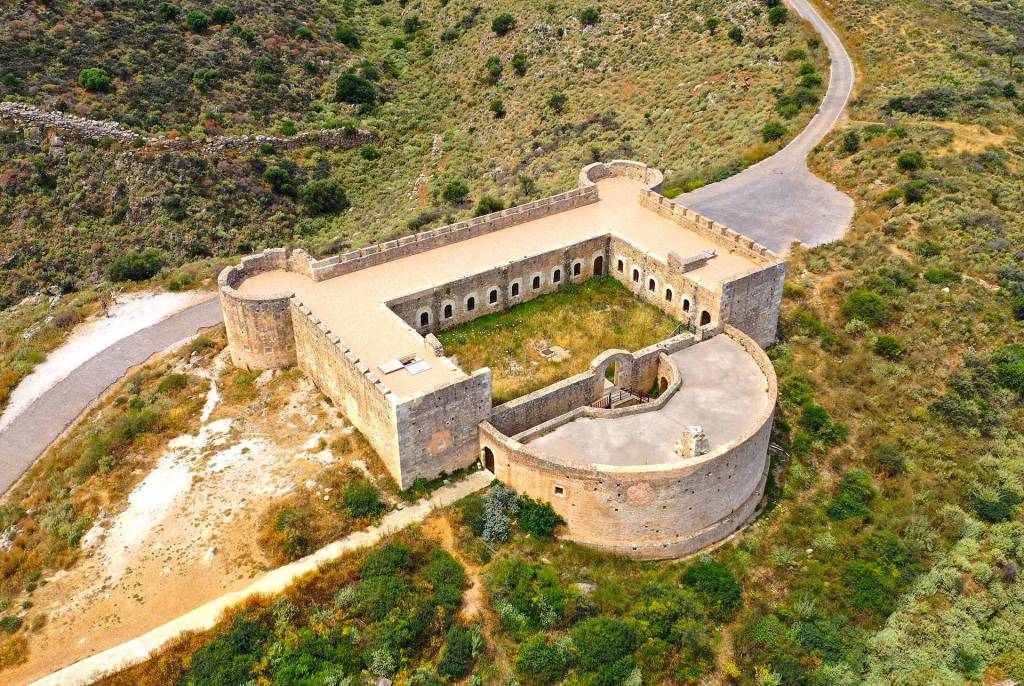
Izzeddin Fortress’ history dates back to 1872 when it was constructed by Reuf Pasha near the present-day Kalami Village. As one of the notable Ottoman forts in Crete, it was strategically placed to safeguard the vital Souda Bay fortifications, which held immense military and naval importance. The fortress was named in honor of Izzeddin, the firstborn son of Sultan Abdulaziz, reflecting its strong ties to the Ottoman dynasty.
Political Prison: Detaining Leaders from Venizelos to Pangalos
Over the years, Izzeddin Fortress evolved from a coastal defense point into one of Greece’s most infamous political prisons. Notable figures, including Eleftherios Venizelos, were detained here following political disputes. During the dictatorship of Theodoros Pangalos, the fortress served as a detention center for political opponents, including Pangalos himself, after his regime collapsed.
World War II and Post-War Use
During World War II, Izzeddin Fortress ceased functioning as a prison and was converted into military barracks under German occupation. In 1948, it resumed its role as a detention center for political prisoners previously exiled to the island of Gyaros.
Significantly, in 1972, the fortress was the site of the last execution under Greece’s death penalty law, with the prison continuing operations for two more years before falling into disrepair.
Izzeddin Fortress in Greek Cinema
Beyond its political and military significance, Izzeddin Fortress in Greek cinema has gained recognition as a filming location. Several prominent Greek directors, including Theodoros Angelopoulos and Pantelis Voulgaris, have used the fortress for its dramatic architecture and historic atmosphere, making it one of the most iconic film locations in Crete.
Visiting Izzeddin Fortress Today
For travelers, visiting the Fortress offers a glimpse into Crete’s complex history. Situated near Kalami Village, it provides panoramic views of Souda Bay and insight into Ottoman military architecture. Today, the fortress stands as a testament to Crete’s layered past and is a must-see for history enthusiasts exploring Souda Bay fortifications.
Discover also: Archaeological Site of Aptera