


The archaeological site of Aptera is one of the most significant remnants of the ancient city of Aptera in Crete, reflecting a rich history that spans several major periods. Founded in the 8th century BC, at the end of the Minoan era, Aptera developed into a dominant city-state during the early Hellenistic period, becoming a center of commerce, military strength, and regional influence.
Origins of the Ancient City of Aptera
The oldest known reference to the name “Aptera” appears as “A-pa-ta-wa” on a Linear B tablet discovered in Knossos, dating back to the 13th century BC, indicating the site’s deep historical roots. The city’s territorial boundaries may have extended as far west as Kydonia and as far south as Lappa, highlighting its significant regional control.
The growth of Aptera is closely tied to its elevated position—about 230 meters above sea level—on the hill known today as Palaiokastro, which offered both a defensive advantage and control over the maritime routes in the bay below. Archaeological and historical evidence confirms that the area was already inhabited during the Minoan period, though most of the preserved remains date from later periods, particularly the Geometric, Hellenistic, and Roman eras.
History and Development of Aptera
The city’s name is thought to derive from an epithet of the goddess Artemis, according to one of the dominant local founding legends. Its strategic location in the region of Megala Chorafia allowed Aptera to maintain authority over a wide territory and two harbors—Minoa, near present-day Marathi, and Kissamos, between Kalami and Kalyves—which positioned it as a key player in regional trade.
This maritime control contributed significantly to its economic strength, especially during the early Hellenistic period, when Aptera began issuing its currency and reached the height of its political and commercial power. Aptera’s reputation extended beyond commerce. The city was known for its accomplished archers, many of whom served as mercenaries, reinforcing the city’s military status.
Decline and Later History
Despite its strength, Aptera eventually declined following a series of destructive earthquakes that shook the eastern Mediterranean in late antiquity. It continued to hold some importance into the Roman and early Byzantine periods, but its eventual destruction was completed by Saracen forces in the early 9th century AD.
Later occupants also recognized the site’s strategic value. The Ottomans built a fortress overlooking Souda Bay to the north, which incorporated earlier Venetian structures. Even in the 20th century, during World War II, German forces used the site as a military base.
Excavations at the Archaeological Site of Aptera
Systematic archaeological work began in the 19th century, led by the French School of Archaeology. The site’s identification as the ancient city of Aptera was confirmed through numismatic evidence, particularly by Robert Pashley.
Later additions include the Monastery of Saint John the Theologian, founded in the 12th century, and the restored Turkish Fortress, originally Venetian and rebuilt in the 19th century. These structures add further historical depth to the site.
What to See at the Archaeological Site of Aptera
Today, visitors to Aptera can enjoy stunning views of Souda Bay and explore a wide range of archaeological remains, including:
- The main theater that was constructed from local fossil-rich limestone
- The rectilinear theatre, which was created after the main one
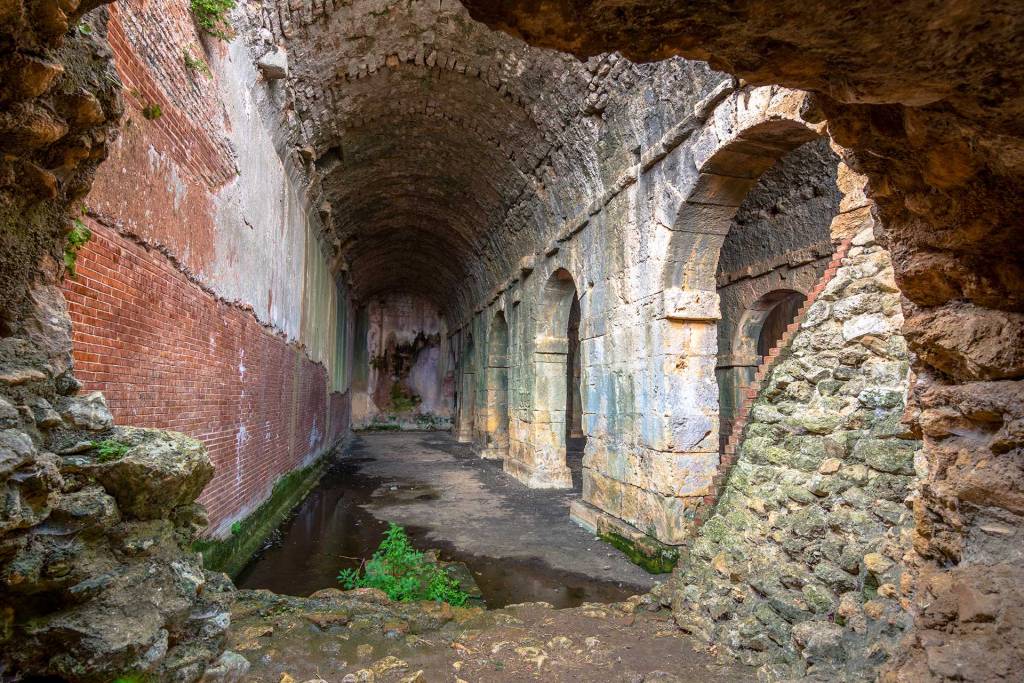
- The Roman cisterns and baths
- A small two-aisled temple dating from the 5th century BC
- A public building
- Remains of a Roman house
- Sections of the fortification walls built before the mid-4th century BC
- The city’s main gate
- Two funerary monuments
- A heroon dedicated to hero worship
Visitors can access the archaeological site daily, except on Tuesdays, between 08:00 and 20:00, upon payment of an entrance fee.