

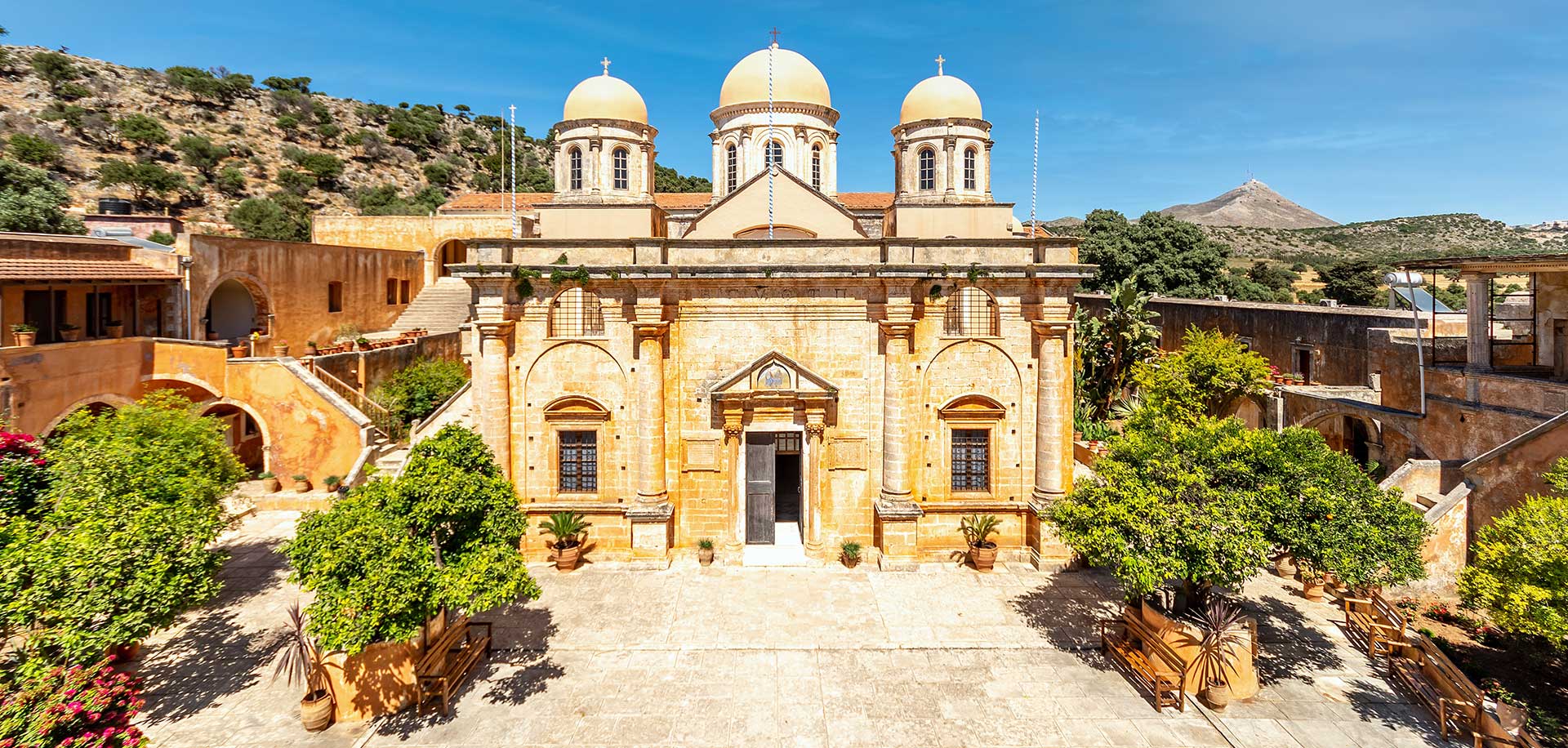
Located on the scenic Akrotiri peninsula, not far from Chania’s airport, Agia Triada Monastery—also known as Holy Trinity Monastery—stands as one of the most remarkable examples of monastic architecture from the final years of Venetian rule in Crete. The monastery was founded in the early 17th century by the Venetian nobles Jeremiah and Laurentius Tzagarolos, who rebuilt a smaller, earlier monastic structure that previously occupied the same site.
RENAISSANCE-INSPIRED ARCHITECTURE AND LAYOUT | HISTORICAL CHANGES AND THEIR INFLUENCE | EXPERIENCING AGIA TRIADA MONASTERY TODAY | MAP
Renaissance-Inspired Architecture and Layout
Drawing heavily from the principles of Italian architect Sebastiano Serlio, Jeremiah Tzagarolos designed a well-organized, four-sided complex that reflects the elegance of the Renaissance. At the heart of the Agia Triada Monastery lies a spacious inner courtyard, dominated by the impressive main church (Katholikon).
Moreover, each side of the complex served a specific purpose. The west wing contains monk cells, historic wine cellars, and an olive mill, while the north wing houses the monastery’s library. Additionally, the south section features the ossuary, further highlighting the site’s religious significance.
Historical Changes and Their Influence
Over the centuries, Agia Triada Monastery Chania underwent several transformations. Particularly in the 19th century, significant additions—such as the domes of the main church and the Seminary—shaped its current appearance. However, during the Greek War of Independence in 1821, the monastery faced devastating destruction when Ottoman forces set it on fire, resulting in the tragic loss of many valuable relics. Later, in 1864, a striking bell tower was constructed, adding yet another notable feature to the complex.
Experiencing Agia Triada Monastery Today
Today, visitors follow a picturesque road lined with tall cypress trees until they reach the grand entrance, marked by a large staircase and a striking Renaissance-style façade. Furthermore, the outer area features vaulted storage rooms on the ground floor, traditionally used for producing and storing olive oil and wine—activities that continue to contribute to the monastery’s reputation.
Despite its long and challenging history, Holy Trinity Monastery Chania Crete remains active, seamlessly combining religious life with cultural heritage. The monastery also supports local production, making it both a spiritual sanctuary and a cultural destination.
Discover also: Gouverneto Monastery and Katholiko Monastery