

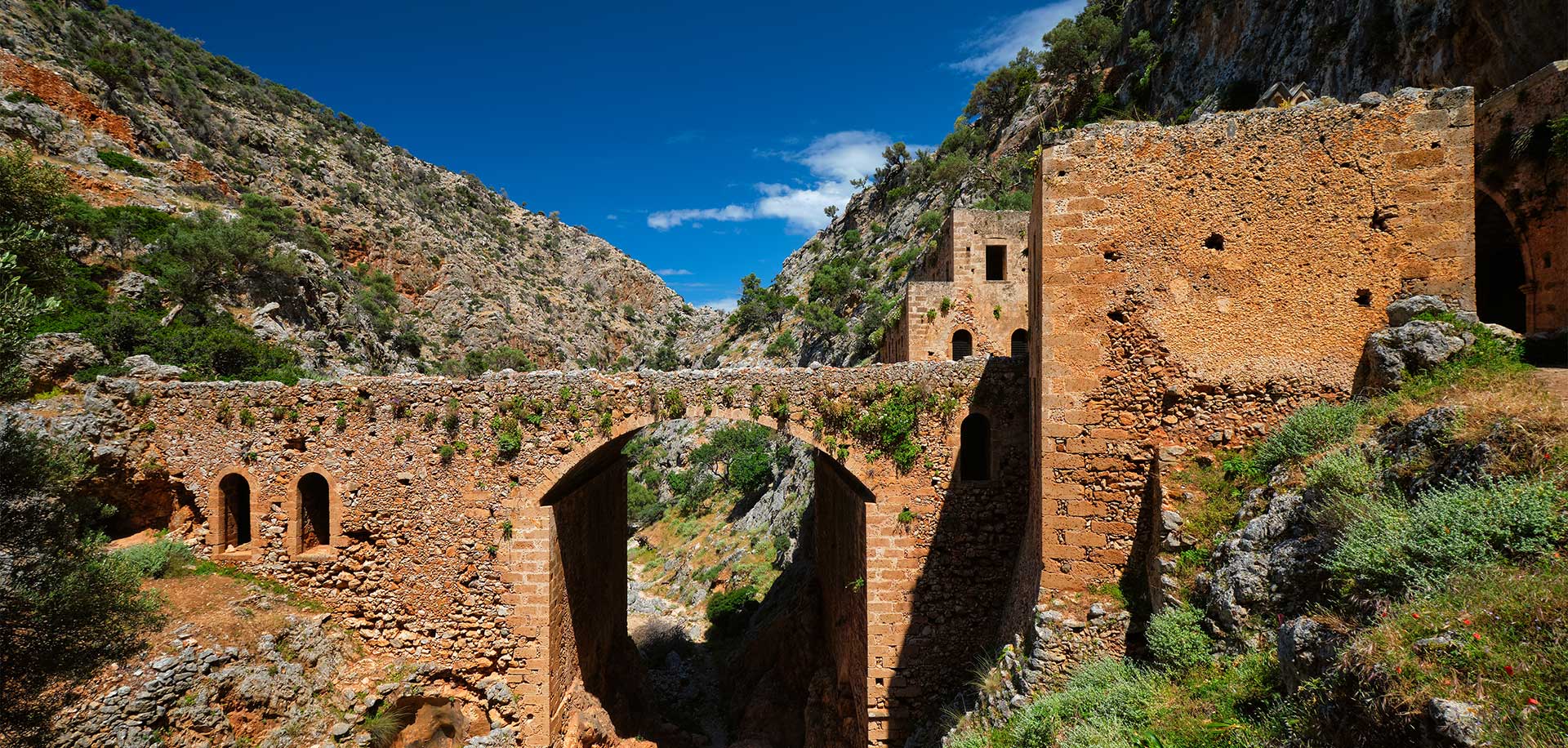
Once, Katholiko Monastery was a thriving spiritual refuge, home to monks, ascetics, and passing pilgrims. Today, although it stands in quiet ruins, its stone arches, ancient bridge, and lonely pathways whisper stories of centuries long gone. Also known as the Monastery Katholiko or the Monastery of Saint John the Hermit, this remarkable site holds a profound place in Crete’s religious history.
LOCATION & ACCESS | THE HERMIT SAINT & THE MONASTIC LEGACY | PIRATE ATTACKS & ABANDONMENT | 17TH-CENTURY REVIVAL | DESIGN | LEGENDS & LEGACY | MAP
Where Is Katholiko Monastery?
Hidden deep within the dramatic Katholiko Gorge (or Avlaki Gorge), the monastery lies in the Akrotiri Peninsula, about 20 kilometers from Chania Town. To reach it, visitors must follow a cobbled trail starting at Gouverneto Monastery. This scenic route—which forms part of the popular Katholiko Gorge hike—takes around 20–30 minutes and offers breathtaking views of rugged cliffs, Mediterranean vegetation, and the path leading toward Katholiko Bay.
Saint John the Hermit: The Origin of a Monastic Tradition
In the 10th century, Saint John the Hermit withdrew into a cave within this remote gorge, seeking silence and devotion. Gradually, his humble lifestyle inspired other hermits to settle nearby. Consequently, a small hermitage formed around him. Even after he died in 1027, devout ascetics continued to arrive, transforming the early settlement into a meaningful monastic community that later evolved into a fully established monastery.
Hardships, Pirate Threats, and Eventual Abandonment
Life in this secluded haven, however, was not without danger. Over time, pirate raids along the Cretan coast increased dramatically, putting the monks’ safety at risk. Therefore, the community made the difficult decision to abandon Katholiko Monastery and relocate to the more secure Gouverneto Monastery.
17th-Century Revival and Architectural Growth
In 1632, Saint John’s official recognition by the Patriarchate renewed regional interest in monasticism. As a result, extensive construction and expansion took place at the Monastery Katholiko, overseen by the nearby Gouverneto Monastery. The structures visible today—including hermit cells, a bell tower, and the striking stone bridge spanning the gorge—likely date from this revitalized era.
Architectural Vision: Jeremiah Tzagarolo and Serlio’s Influence
During the 17th century, further development unfolded in front of Saint John’s cave under Jeremiah Tzagarolo, who worked from architectural designs by Sebastiano Serlio. Because of this, the monastic complex achieved the dramatic form we see today. Beneath the large bridge lie vaulted storage rooms, while nearby stand two-storey guest buildings once used to shelter pilgrims. Additionally, the surrounding caves—once the homes of early hermits—were gradually replaced by more permanent monastic dwellings.
Legends, Myths, and the Enchantment of Katholiko Bay
Just beyond the ruins awaits Katholiko Bay, a small fjord of crystal-clear waters that once served as the monastery’s port. Near the shoreline rises a rock formation resembling a ship. According to local lore, this was once a pirate vessel turned to stone by the abbot’s curse—a dramatic legend that still captures visitors’ imaginations. Today, the scenic descent toward the bay forms part of the memorable Katholiko Bay hike, completing the experience for adventurous travelers.