

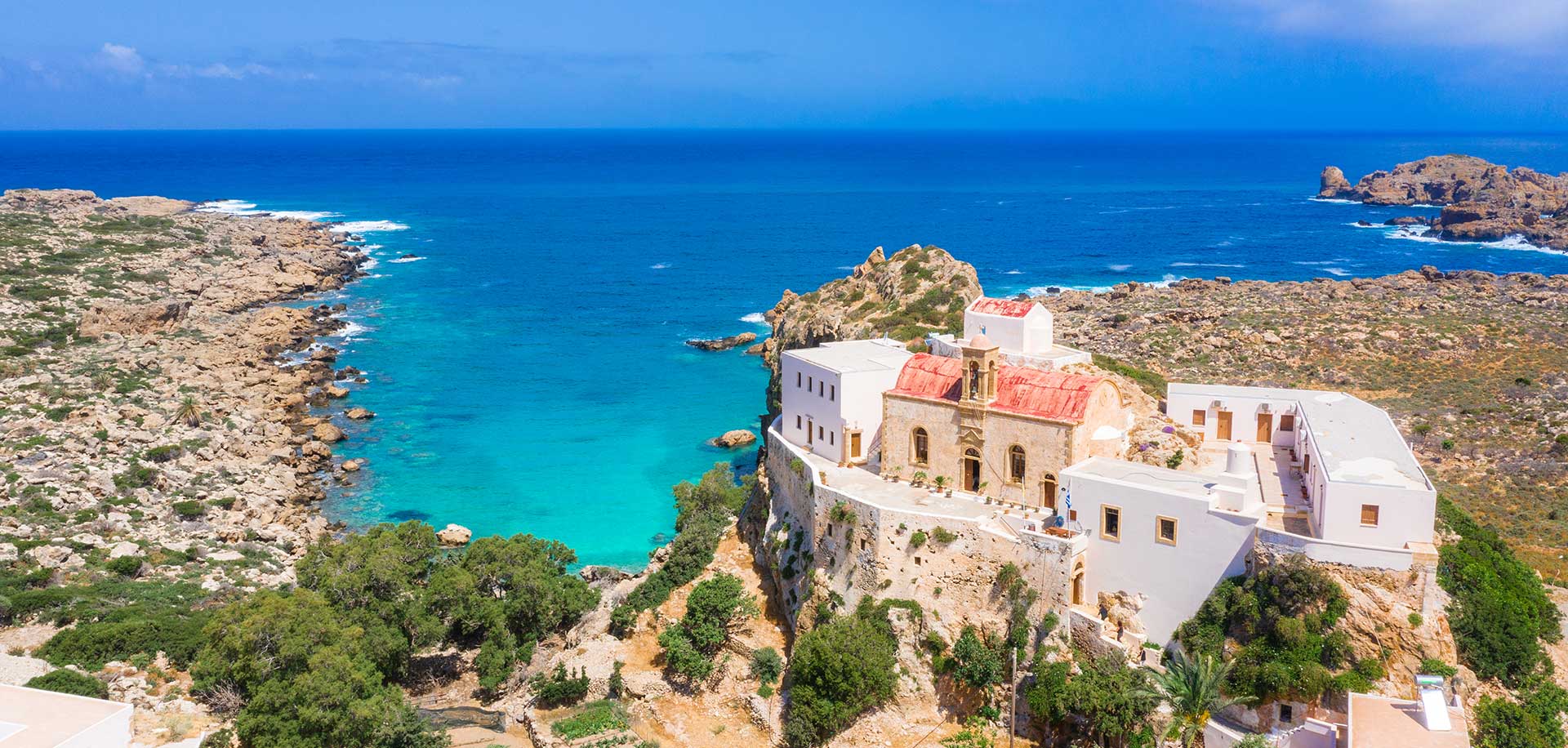
On the dramatic southern coast of Crete, not far from the famous turquoise waters of Elafonisi Beach, stands the Chrysoskalitissa Monastery—also known as Moni Chrisoskalitissa. Rising 35 meters above sea level, Chrysoskalitissa clings to a rugged cliff like a vigilant guardian. With its fortress-like presence and sweeping views of the endless open sea, it perfectly blends spiritual solemnity with the raw beauty of nature.
ORIGINS AND EVOLUTION | THE ENIGMATIC GOLDEN STEP | MIRACULOUS ICONS AND THE VISION | THE 1824 ELAFONISSI MASSACRE | SAINT BASIL’S ICON AND THE WARTIME MIRACLE | TRADITION, CELEBRATION, AND LIVING SPIRIT | MAP
Origins and Evolution of Moni Chrisoskalitissa
Although the exact founding date of the Chrysoskalitissa Monastery remains uncertain, historians believe it was established in the late Venetian period. For many years, it functioned as a nunnery until 2012, when a monk was appointed following the passing of the last nun. Today, the monastery opens mainly during the summer months. Furthermore, many visitors combine their visit with a refreshing swim at nearby Elafonisi, creating a memorable cultural and natural experience.
The Enigmatic Golden Step: A Legend That Endures
The monastery’s name, meaning “Golden Step” in Greek, comes from a long-standing local tradition. According to legend, one of the monastery’s 98 stone steps was made of gold—yet it could only be seen by those with a pure heart and unwavering faith. Alternatively, a more practical explanation suggests the gold step may have been sold by the Patriarchate to help the monastery financially. Regardless of which version is true, the mystery adds a captivating layer to Chrysoskalitissa and deepens its spiritual allure.
Miraculous Icons and the Vision That Shaped the Monastery
Inside the church, several revered relics draw the attention of pilgrims and visitors alike. Most notably, the 17th-century icon of the Assumption of the Virgin Mary features an unusual detail: the Virgin’s head appears on the right side rather than the traditional left. A curious marble mark also remains unexplained, further intensifying its sacred reputation.
Moreover, tradition tells of a shepherd who first discovered the icon after witnessing a supernatural light on the rock. The Virgin is said to have appeared to him, instructing that a church be built. Although the first temple was placed on lower, more convenient ground, the Virgin reportedly appeared again, insisting that the church be established exactly where the icon was found. Miraculously, the solid rock softened, allowing construction to begin—another story that strengthens the monastery’s spiritual legacy.
The 1824 Elafonissi Massacre and a Miracle of Protection
Just a short distance from Monastery Chrysoskalitissa, the tragic Elafonissi Massacre of 1824 claimed the lives of more than 600 locals. During the same period, the monastery itself faced imminent destruction as Turkish forces approached. Yet, according to tradition, a swarm of bees suddenly attacked the invaders and forced them to retreat. This extraordinary event is commemorated with an icon at the monastery’s lower entrance, symbolizing what many consider divine intervention.
Saint Basil’s Icon and the Wartime Miracle of 1943
Another remarkable story comes from the period of German occupation in 1943. During an attack, a machine-gun bullet struck the icon of Saint Basil. The bullet pierced the wood but stopped abruptly near the saint’s figure, an event still regarded by many as a miracle. This powerful symbol of protection further strengthens the spiritual identity of Moni Chrisoskalitissa.
Tradition, Celebration, and the Living Spirit of Chrysoskalitissa
Even today, the Chrysoskalitissa Monastery remains a place of profound faith and reflection. Every year on August 15th, worshippers gather to celebrate the Dormition of the Virgin Mary. This annual event not only honors centuries-old traditions but also keeps alive the extraordinary stories, miracles, and resilience that define this cliffside sanctuary.