

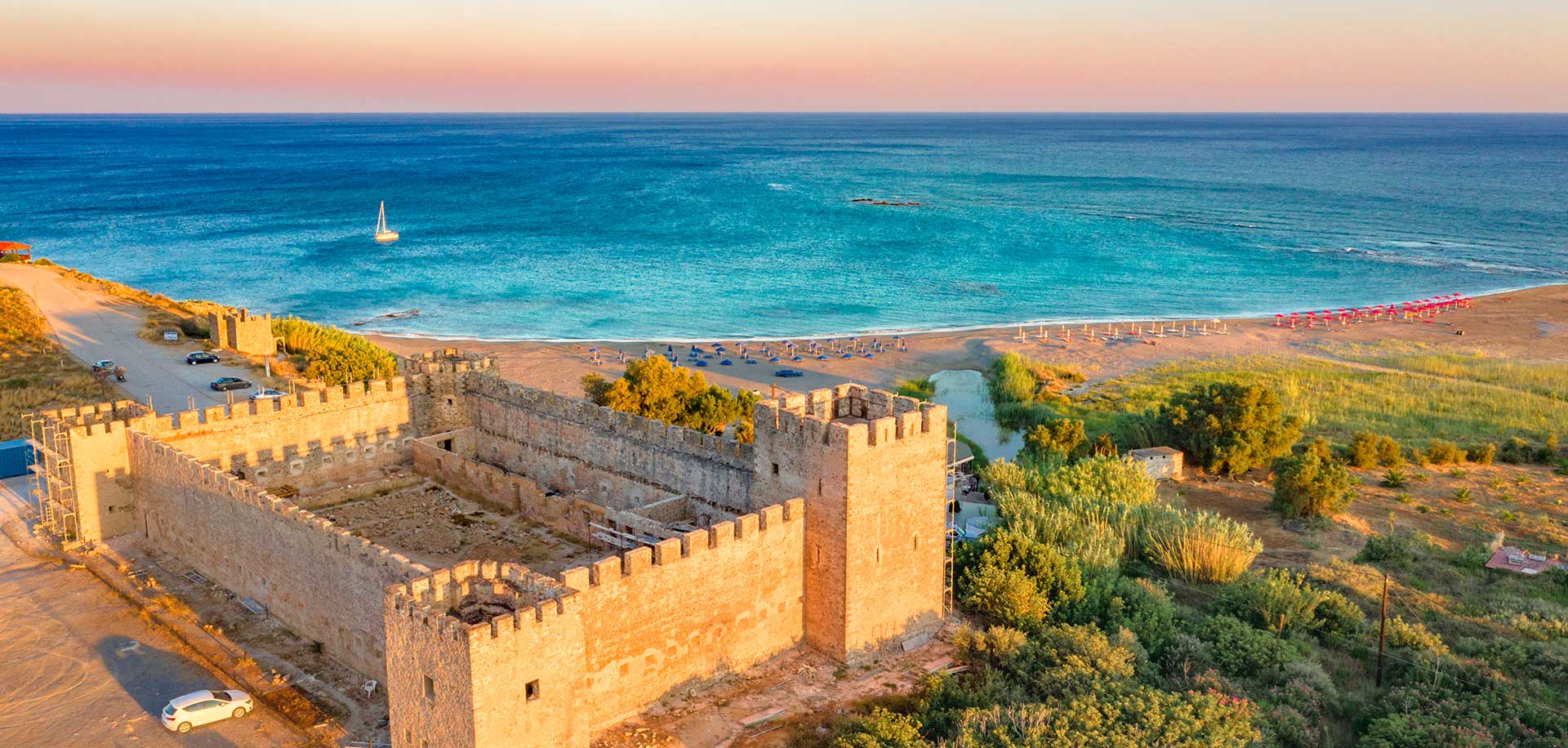
Frangokastello is a small, well-preserved seaside fortress built directly along the southern coastline of Crete. Constructed by the Venetians between 1371 and 1374, its original purpose was to defend the area from pirate attacks as well as frequent uprisings by the Sfakian inhabitants. Though officially named Castle of Saint Nikitas by the Venetians, the structure came to be known as “Frangokastello”, meaning “Franks’ Castle”, a name coined by the local population who referred to all foreign Catholics as Franks.
Frangokastello Fortress: Venetian Construction, Local Resistance, and Architectural Legacy
Located approximately 12 kilometers east of Chora Sfakion on the south side of Chania, the Fortress holds significant historical and cultural value. Its construction was reportedly met with local resistance; according to tradition, the Sfakians, under the leadership of the Patsos brothers, destroyed the progress made by Venetian troops each night. Eventually, the Venetians captured and executed the brothers, allowing construction to be completed.

The Castle is rectangular with a tower at each corner. However, the southwest tower stands out as the most important due to its defensive role in protecting the main entrance.
Above the gate, several Venetian coats of arms can still be seen, including that of the Republic of Venice and others belonging to influential families.
The structures visible within the castle today were rebuilt toward the end of the Ottoman occupation in the 19th century.
Frangokastello Castle in the Greek War of Independence: The Battle of 1828
Frangokastello also played a role during the Greek War of Independence. In 1828, the Greek chieftain Hatzimichalis Dalianis occupied the castle with around 700 men. On May 17 of the same year, a major battle took place between the Greek defenders and Ottoman troops led by Mustafa Naili Pasha. The Greek forces were defeated, many were killed, and the castle was temporarily damaged to prevent future use by rebels.
The Mystery of the Drosoulites
This event became the origin of the famous Drosoulites phenomenon—a rare occurrence reported in the area on some late spring mornings. According to local accounts, shadowy, human-like figures appear in the plain near the castle, moving silently in formation. These apparitions are said to represent the fallen warriors of the 1828 battle, seen marching toward the fortress before fading near the sea. This phenomenon has contributed to the castle’s reputation as one of Greece’s most famous.
Discover also: Frangokastello Village and Frangokastello Beach